
Q4 2025
A volatile, uncertain world and challenging trading conditions are testing business leaders’ resilience. In spite of this, there are signs of optimism among company bosses that better times could lie ahead, for their businesses at least.
This is a key finding from the HPA Economic and Business Outlook survey, carried out in partnership with Eden McCallum. Over 350 business leaders in the U.S., UK, and the rest of the world were asked for their views on the domestic and global economy and future business prospects. Their varied responses reflect a world that is in a state of flux, but which may also be poised for more rapid growth.
Economic outlook
Almost half (46%) of respondents are pessimistic about the global economy, and only a quarter (23%) are optimistic. Similarly, 62% of all respondents are pessimistic about their domestic economy and only 22% are optimistic, also a rather gloomy finding. And yet two-thirds say they are optimistic about their own business’s prospects, an increase on last year. The world outside may look daunting, but in the C-suite, business leaders can see a positive way forward.
In the U.S., leaders are more pessimistic (61%) about the domestic economy compared to the global economy (41%). Interestingly they are much more bullish on their businesses, with 72% of U.S. respondents saying good times lie ahead for their business. In the UK, gloom about the domestic economy is particularly pronounced: 85% are pessimistic (3 in 10 ‘very pessimistic’) and only 5% are optimistic.
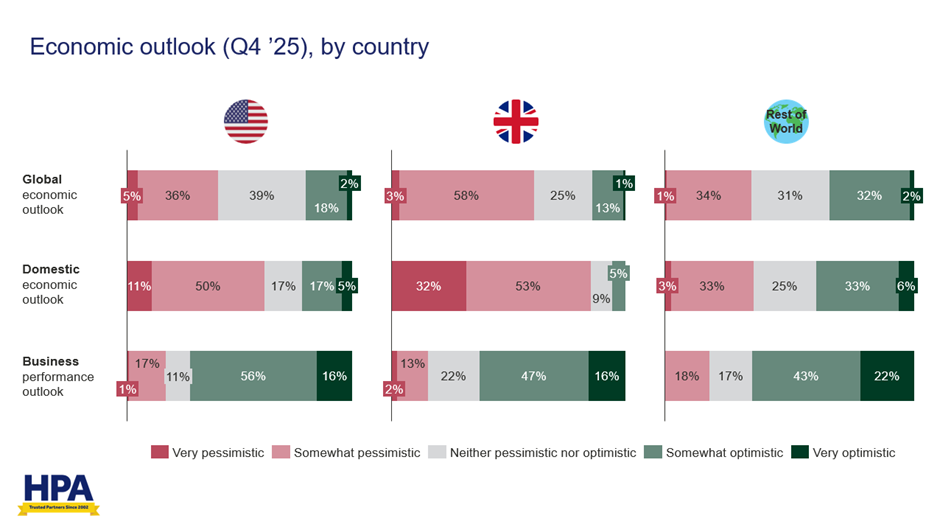
In the rest of the world (RoW), the outlook is more balanced, with a roughly equal share of optimists and pessimists as far as the global and domestic economies are concerned. However, the results in the RoW also show relatively lower levels of pessimism about the economy and high levels of business optimism.
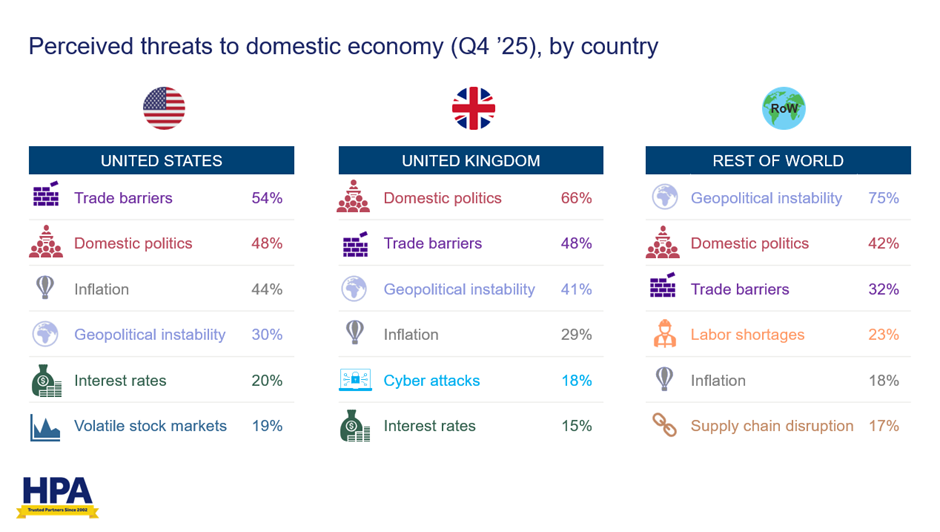
Overall, the biggest perceived threats to national economies are domestic politics (53% say so), geopolitical instability (48%), and trade barriers/tariffs (45%). But the picture differs greatly across countries.
For U.S. business leaders, trade barriers are the biggest issue (54%), although domestic politics (48%) and inflation (44%) also loom large. In the UK, domestic politics are by far the biggest cause for concern (66%), and geopolitical instability is the dominant concern for rest of the world respondents (around 75% cite this – nearly double the proportion citing it in the UK and 2.5x the U.S.).
Changing customer demand
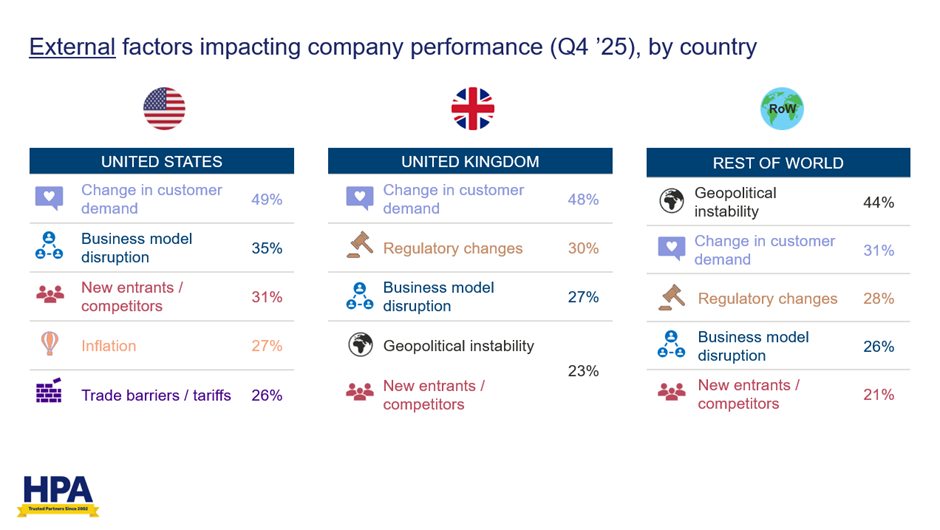
In terms of what will have an impact on business performance, change in customer demand stands out as the most frequently mentioned factor (by 43% of respondents). The next most commonly cited factors, by nearly a quarter of all respondents, are business model disruption, geopolitical instability, regulatory changes, and new entrants, with trade barriers cited by 1 in 5. U.S. and UK respondents are more concerned about changes in customer demand and less concerned about geopolitical tensions compared with those in RoW.
Data and digital
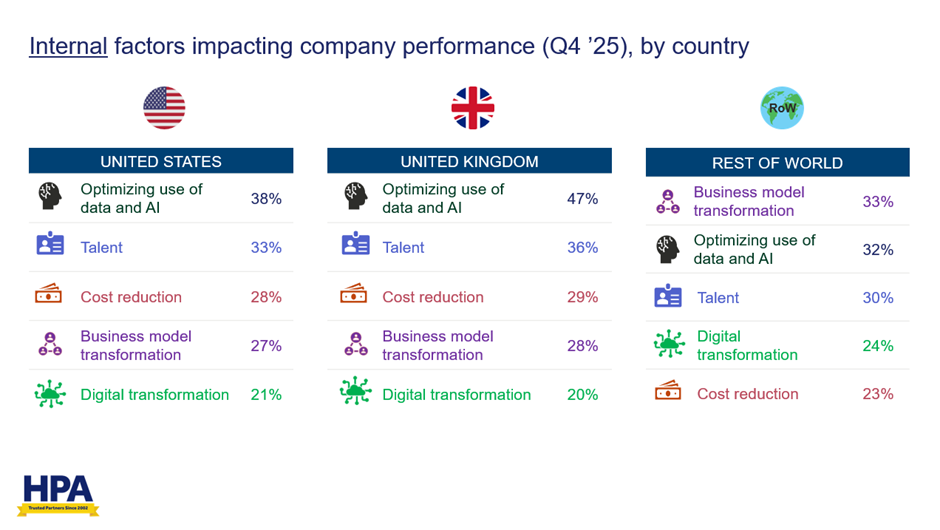
In terms of internal issues, optimizing the use of data / AI is the top focus for business leaders (cited by 39%), followed by talent acquisition and retention (33%) and business model transformation (29%). With GenAI adoption at the forefront of many corporate agendas, it is no surprise that data / AI optimization is a top priority.
Tariffs
Though the tariff threat has moderated slightly over the past 6 months, pessimism among business leaders still remains. Even where businesses have limited activity in the U.S., nearly two-thirds of business leaders expect tariffs to have a negative impact on their companies. Only 4% of all respondents expect them to have a positive impact.
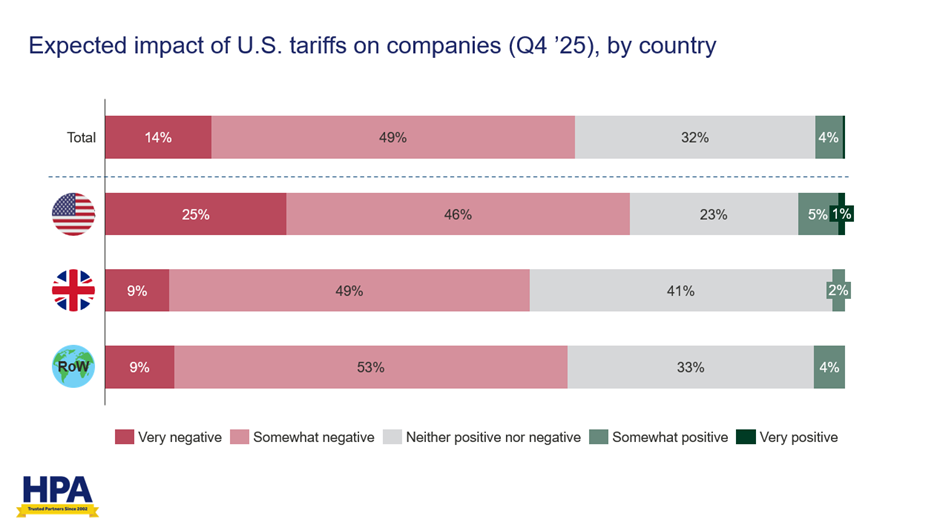
Business leaders expect tariffs to have their biggest impact on revenue, costs, and the supply chain. Tariffs are also undoubtedly impacting consumer demand, which lies behind the revenue concerns. As one business leader noted: “The direct financial impact is largely manageable; it’s the indirect impact on consumer confidence, particularly in the U.S., and supply chain disruption that are more problematic to deal with.”
With concern high, 45% of companies are currently taking action or exploring their options in response to the announced tariffs across a broad range of areas, including supply chain, pricing, cost reduction, and a shift in sales focus as well as reforecasting their financials.
Sumeet Goel, founder of HPA, noted several interesting takeaways from the global survey results.
“AI in the #1 spot in terms of internal performance factors is notable – this would probably not have been the case a year ago. Additionally, it’s interesting that nobody sees tariffs as having a positive impact on their business; it’s a sub 5% positive response whether they’re U.S. based or not. On the other end of the spectrum, we may find some humor in the fact that most executives are optimistic about their own business but somehow equally pessimistic about their country’s economy. Fascinating!”
View the survey results below:
hpa-economic-and-business-outlook-survey-q4-2025-1st-half-finalFollow us on LinkedIn to remain updated.
