Written by James Birkland and Mikaela Celeste
At HighPoint Associates (HPA), our ability to deliver exceptional client outcomes depends on one thing above all else: the strength of our people. As our associate team of recent graduates doubled, we faced a challenge familiar to many firms: how do we accelerate the development of early-career consultants so they can confidently contribute to high-stakes client work?
Among many tools, we turned to Hogan Assessments to answer that question.
Hogan Assessments are commonly used by organizations to understand employee strengths, potential derailers, and underlying motivations in the workplace. While the assessments can serve many purposes, at HPA we intentionally positioned Hogan as both a recruiting and development tool. We wanted to use the Hogan Assessments to illuminate how our people naturally think, work, and show up, and how they can grow into even stronger contributors on client engagements. What began as a simple diagnostic evolved into something far more powerful: a behavior-based development engine that helped our associates build self-awareness, sharpen judgment, and strengthen communication skills that directly shape client impact.
This approach is uncommon in our industry, where traditional firms typically rely on standardized training to build broad consulting skills. At HPA, we’re intentionally doing something different: investing earlier, tailoring development to each individual, and using behavioral insights to accelerate readiness for meaningful client work.
The result wasn’t just a training program. It became the foundation of a learning culture that is reshaping how our people collaborate with each other and drive impact for clients.
I. Why We Started: Building Talent and Culture at HPA
HPA’s client work is delivered by experienced consulting teams including HPA associates. Our associates act as one connective tissue across internal initiatives, delivery, and culture-building. As the group grew, so did the need for structure. Our associates were ambitious, eager, and ready to take on more responsibility, but they wanted more structured support in developing the fundamentals of consulting. At the same time, leadership recognized the importance of creating a consistent developmental path, one that would strengthen the firm’s culture and ensure long-term scalability.
We needed a way to anchor development not just in skills, but in behavior, habits, and self-awareness. That’s where Hogan came in.
II. Using Hogan Differently: From Assessment to Development Engine
We made a deliberate choice to use Hogan in a way that goes beyond traditional selection. Every employee at HPA, from leadership to associates, completed the full Hogan Assessment suite which includes the HPI, HDS, and MVPI1. We then anonymized and aggregated the data across cohorts to look for patterns that would guide our learning and development strategy.
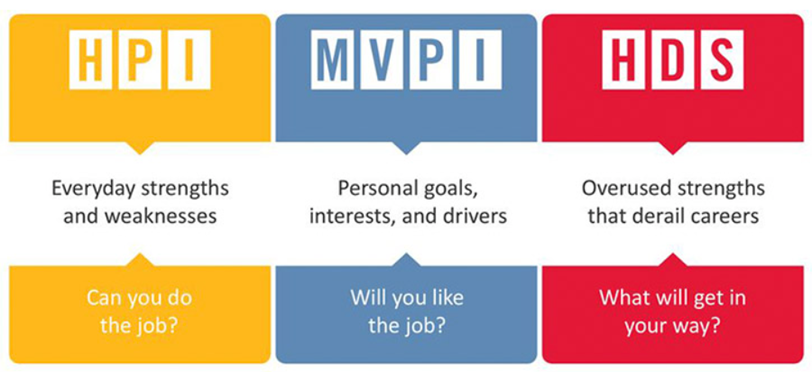
The goal was not classification. It was clarity. By understanding where our people naturally excelled and where predictable challenges surfaced, we could design a development approach grounded in real behavior rather than guesswork. The insights we gained helped us build learning experiences that met our associates where they were, supporting their growth in ways that ultimately elevate consulting readiness and strengthen client delivery.
III. What We Learned: Behavioral Insights from the Data
When we studied the associate cohort’s results, a clear picture emerged. The Hogan data showed that our associates had a strong desire to influence and contribute, and they brought deep curiosity and motivation to learn. At the same time, many were still building the confidence to speak up in higher-stakes situations or translate that curiosity into practical application. We also saw opportunities to help them strengthen communication, sharpen prioritization, and develop a healthier, more effective approach to conflict and assertiveness. In short, we had high-potential talent whose strengths could be accelerated with the right structure and support. Hogan gave us the roadmap.
IV. Turning Data into Development: Designing the HPA L&D Journey
The insights from Hogan became the foundation for our Learning & Development roadmap. Rather than creating one-off training courses, we built a multi-module journey designed to follow the natural progression of consulting readiness. The result was a program anchored in five core pillars: Persuading, Managing Relationships, 80/20 Prioritization, “Get Smarter” Continuous Learning, and Career Development.
Global leadership research shows that 83% of HR organizations expect rising demand for “future-focused” leadership capabilities in the coming years. Leaders today want employees who can do more than hit quarterly targets; they expect them to help shape the future of the business and grow into leaders themselves.2
But that aspiration rarely becomes reality. Nearly 60% of leaders say they want to develop these future-focused skills, yet those very capabilities (setting strategy, managing change, sound decision-making, prioritization, and developing others) remain among the least developed. Only 37–39% of leaders report ever receiving training in them.3
That gap is exactly why our L&D journey focuses on persuasion, relationship-building, 80/20 thinking, continuous learning, and career clarity. Our program closes that gap by focusing on the behaviors that directly drive client value, the same capabilities that shape influence, judgment, and resilience. These are skills early-career consultants rarely get structured opportunities to build, particularly in a boutique environment.
The Persuading module, which launched first, immediately changed the energy of the team. It introduced frameworks for structuring ideas, using data effectively, and tailoring communication to different stakeholders and it laid the groundwork for upcoming modules.
V. The Persuading Module: A Month of Practice, Application, and Growth
The Persuading module unfolded over four weeks, each anchored in an hour-long interactive session. We began with the fundamentals of persuasive communication and gradually advanced to structured story lining using the SCR (Situation–Complication–Resolution) framework. From there, we explored using data to strengthen arguments and tailoring messages to different stakeholders’ priorities and values.
The module culminated in a “Candy Bar Pitch-Off,” where associates worked in small teams to pitch a fictional product to senior leaders. The room was energetic and engaged, and the presentations showed just how much the group had grown. During the Pitch-Off, teams applied the SCR framework to craft compelling arguments, introduced sharper storylines with logical flow and prioritization, and presented with stronger tone, presence, and visual clarity. Senior leaders commented afterward that the overall quality of communication, and the confidence behind it, had materially improved in just four weeks.
VI. Measuring What Matters: What Changed in the Data
To capture the impact of the program, we ran pulse surveys before and after the Persuading module, and the shift was both immediate and significant. Across all eight persuasion competencies, the percentage of associates who “agree” or “strongly agree” increased, often dramatically. For example, confidence in effectively persuading others rose sharply, with “strongly agree” responses more than doubling from 14% to 33%. The biggest leap, however, came in proactive communication: before the module, 72% of associates felt comfortable advancing ideas without waiting for direction; after the module, that number reached 100%, with every respondent agreeing or strongly agreeing. We saw similar movement in other foundational skills. All associates reported that they could use data to make their case compelling and ask for clear decisions or next steps, up from 93% pre-module. And the share of associates who “strongly agree” that they can tailor messages to different stakeholders jumped from 36% to 56%.
Even the more challenging consulting behaviors showed notable growth. Agreement that associates could take thoughtful risks when advocating for change rose from 50% to 78%, and the same increase appeared in their ability to recover quickly when ideas were challenged. These are the kinds of behaviors that meaningfully shape how consultants show up in client settings, and the data showed us that the module accelerated that readiness.
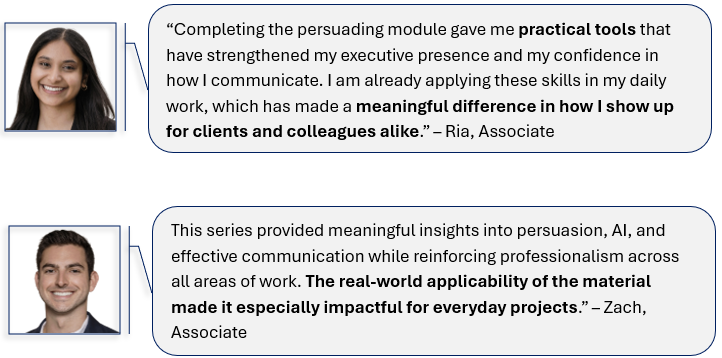
But the story wasn’t just quantitative, it was visible. In day-to-day interactions, associates began speaking up with more clarity and structure, framing recommendations more concisely, and using data and storylines more intentionally. Leaders across the firm noted a noticeable shift in confidence and presence, particularly in how associates participated in discussions and articulated their thinking.
This focus on development also matters for something more fundamental: trust. Research shows that employees whose managers actively support their growth are 11x more likely to trust those managers, and those who receive regular feedback are 9x more likely to feel high trust.4 By investing in development and feedback, we weren’t just building skills, we were strengthening the relational foundation that enables high-performing teams and, ultimately, stronger client delivery.
VII. What Surprised Us: A Personal Reflection
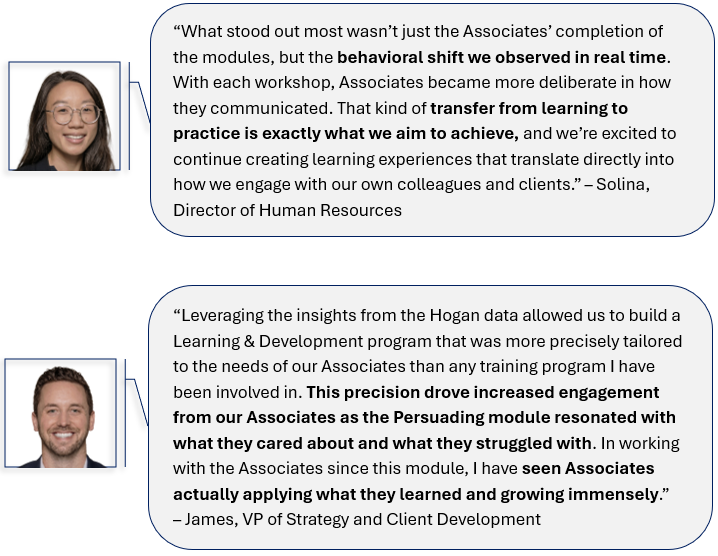
What surprised us most was not the improvement; it was the enthusiasm. Associates did not simply attend the sessions; they immersed themselves in them. They came prepared, practiced outside of workshops, challenged each other thoughtfully, and actively sought feedback. Their mindset shift reinforced something important: when you give young professionals structure, tools, and investment, they rise to the occasion.
This experience reminded us that development is not a distraction from work, it is a catalyst for better work. It creates connection, boosts motivation, strengthens belonging, and builds confidence. In a firm like HPA where every individual has impact, these shifts matter.
VIII. What’s Next: Managing Relationships, 80/20, and Beyond
The journey continues. In February 2026, we will introduce the 80/20 Prioritization module, followed by Managing Relationships in March. Our “Get Smarter” series will continue meeting every three weeks, creating a rhythm of learning, reflection, and shared perspective. We’re also partnering with leadership on the design of our career development to bring more clarity, structure, and alignment to growth paths across the firm.
We’re building a sustainable cycle of development: insight leading to skill-building, skill-building leading to measurable impact, and that impact informing the next phase of our learning strategy.
IX. Why This Matters, For Us and for our Clients
In an innovative firm like HPA, where every person shapes the culture and every behavior influences how we show up for clients, investing in behavioral insight has become a strategic advantage. When people understand their strengths, motivations, and tendencies, they grow faster, collaborate more effectively, and bring greater clarity and confidence to client work. This is why we believe insight-led development is not simply an internal initiative; it is a direct investment in the quality of the client experience.
Talent that is supported, challenged, and understood flourishes. When early-career consultants receive structured, personalized development, they build the influence, judgment, and communication skills that clients feel immediately in meetings, deliverables, and day-to-day interactions. In that sense, programs like ours are not “training”, they are a foundation for consistency, maturity, and excellence in delivery.
We did not just build a training program. We built a culture of learning, reflection, and continuous improvement, one that strengthens how we work with each other and how we serve our clients. And this is only the beginning.
1 Hogan Assessments. (n.d.). About Hogan. https://www.hoganassessments.com/
2 DDI. (2025). Global Leadership Forecast 2025: Insights and trends. https://www.ddi.com/research/global-leadership-forecast-2025
3 DDI. (2025). Global Leadership Forecast 2025: Insights and trends. https://www.ddi.com/research/global-leadership-forecast-2025
4 DDI. (2025). Global Leadership Forecast 2025: Insights and trends. https://www.ddi.com/research/global-leadership-forecast-2025
