
The latest HPA Economic and Business Outlook Survey suggests we may be at a pivotal point. While business leaders remain optimistic about their companies’ prospects, they’re also grappling with heightened uncertainty across geopolitics and technology.
Last month, we surveyed 264 global business leaders across a range of industries and geographies, with a focus on the U.S., UK, and the rest of the world (RoW). The findings show companies navigating the effects of the Iran war while also adjusting to emerging pressures from shifting consumer demand, rapid technological change, supply chain disruption, and commodity price volatility.
Economic outlook
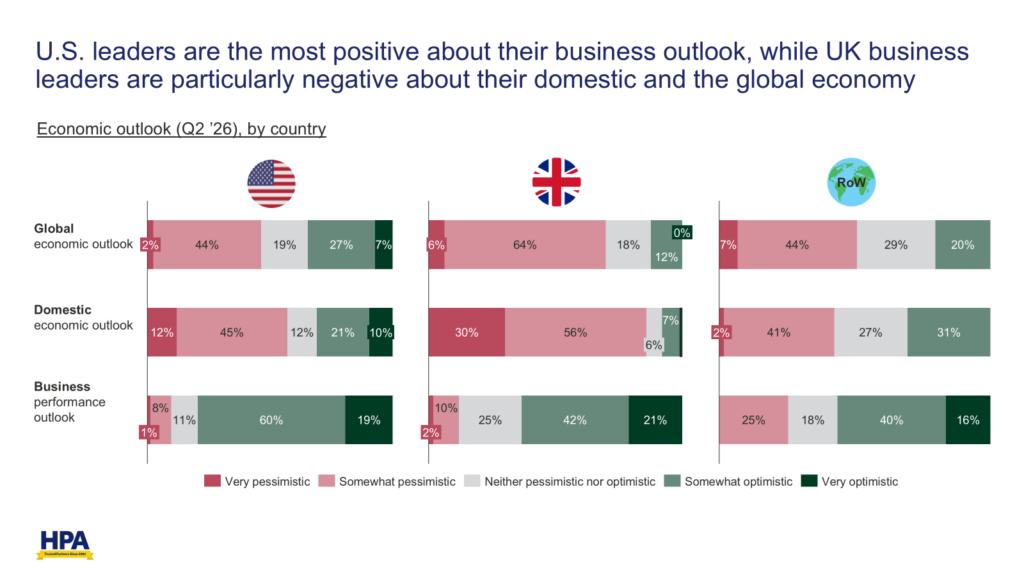
Global economic sentiment has grown slightly more optimistic compared to six months ago, though the picture is more polarized than it may appear on the surface. U.S. leaders have shed the neutral middle ground they held in Q4 2025, shifting toward more extreme views in both directions, and yet they feel slightly more optimistic about the domestic economy and their business performance.
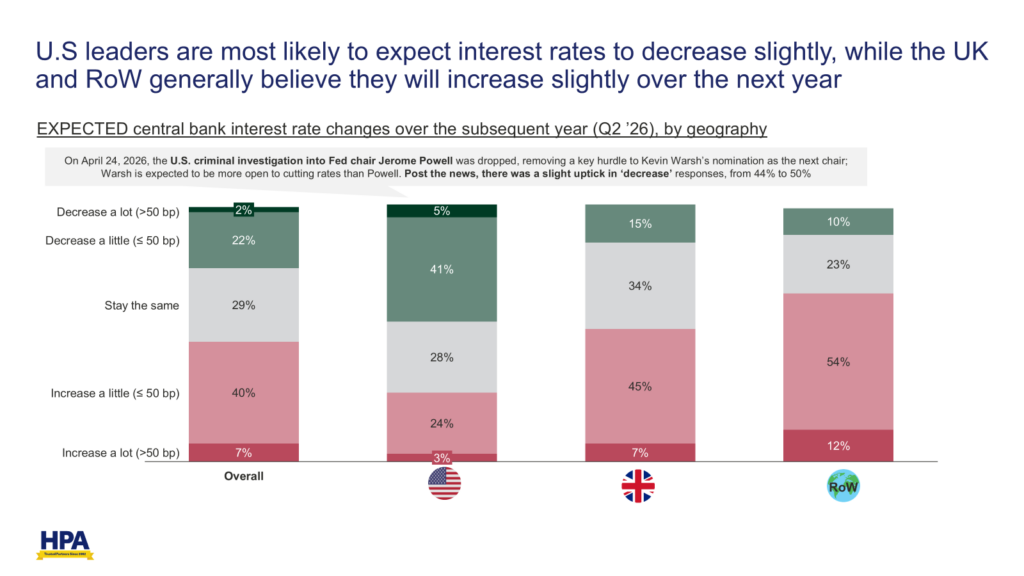
On monetary policy, nearly half of business leaders globally expect interest rates to rise over the next year, though U.S. leaders are more divided on the question. Only 27% anticipate increases while a meaningful share expects cuts, a view likely shaped by the drop of the criminal investigation into Fed Chair Jerome Powell, clearing a path for the appointment of Kevin Warsh, who is widely seen as more rate-cut-friendly. Inflation pessimism remains a consistent theme across geographies, with just over half of respondents globally expecting inflation to return to target (2%) beyond 2028.
Business outlook
Despite what appears to be a highly unpredictable economic environment, corporate leaders are yet again confident about their own operations. Globally, almost 70% of business leaders report being optimistic about their company’s performance outlook over the next 1-2 years. American executives are the most positive about their business outlook, with nearly 80% reporting they are ‘very optimistic’ or ‘somewhat optimistic’, an increase of 7% from six months ago.
Internal factors
Internally, optimizing the use of data and AI remains the leading strategic priority across all three geographies, cited by 57% of U.S. leaders, 52% in the UK, and 41% in RoW. The increasing importance of AI optimization is evident in the U.S., where the share of leaders identifying it as a top priority increased by nearly 20% over the past six months, reflecting accelerating urgency around the topic.

External threats
One of the most significant takeaways is the shift in what leaders perceive as the greatest threats to their domestic economies. In the U.S., perceived threats have shifted dramatically over the past six months:
Tariffs and trade: Concerns around tariffs have fallen, dropping from 54% to 33% over the same period
Geopolitical instability: More than doubled from 30% in late 2025 to 64% this quarter
Commodity prices: Spiked from 7% to 25%, a significant enough jump to land in the top five perceived threats

Much of this geopolitical anxiety is driven by active global conflicts. Globally, at least 50% of all survey respondents report that their organizations have been at least “somewhat impacted” by the ongoing war in the Middle East, while U.S. leaders report being slightly more insulated than their international counterparts. For those affected, the primary operational blow has come in the form of increased energy prices, followed closely by a tempering of demand for products and services. The data also suggests a link between feeling impacted by the war and holding a negative outlook on company performance.
View the full Q2 2026 survey results below:
If you missed the previously published Q4 2025 survey results on changing customer demand, data and digital, and tariffs, you can read here.
Follow us on LinkedIn to remain updated.
