
The second half of our Q2 2026 Economic and Business Outlook Survey, focused on GenAI and the workforce, signals we have reached an inflection point: business leaders are moving past early experimentation, into a phase of more deliberate organizational change.
In April 2026, HighPoint Associates and Eden McCallum surveyed >250 global business leaders to understand how they are managing this rapid technological transition. The results show divergent strategies, primarily by company size. Individual experimentation with AI is now a baseline expectation among smaller organizations, while larger enterprises lean towards more aggressive action: upskilling teams, hiring dedicated AI talent, and building agentic workforces to streamline operations.
Data and AI as a Top Priority
Optimizing the use of data and AI ranks as a top strategic priority globally, cited by 51% of executives. That priority is taking shape in three main ways: 1) experimentation, 2) use-case sharing, and 3) most notably, agentic adoption.
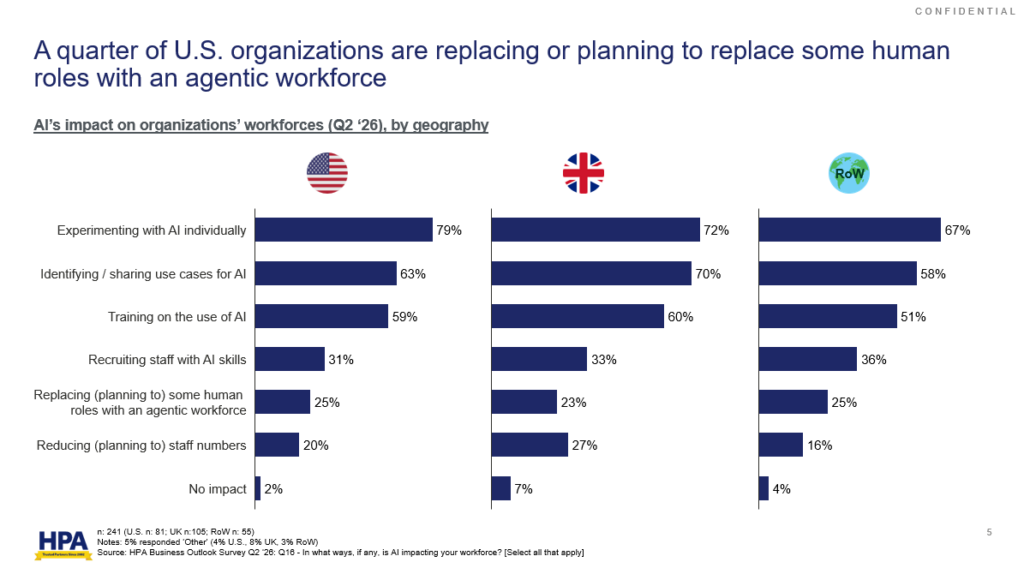
- AI experimentation is a universal focus area, led by the U.S. (79%), and followed by the UK (72%) and RoW (67%)
- Identifying and sharing use cases is a top three commitment across 70% of UK firms, followed by the U.S. (63%) and RoW (58%)
- Agentic adoption marks the most disruptive shift, with a reported 40% of organizations deploying AI agents alongside human teams to some degree. Adoption is the strongest in the U.S. and RoW, where 25% of firms are actively planning to replace human roles with agents, followed by the UK (23%)
The State of AI Training
Enthusiasm for AI training is widespread, but training depth lags. Roughly 60% of companies report providing at least some AI training, led by the UK (60%), and followed by the U.S. (59%) and RoW (51%). However, only about 30% of organizations globally have trained more than half their workforce, leaving most employees without deep exposure to the tools being introduced.
This gap varies significantly by sector. Financial services (61%) and B2B/Professional Services (47%) report the highest share of organizations training more than half their staff. Industrials and Manufacturing trail behind at 11%, with Consumer Goods and Retail at just 6%.
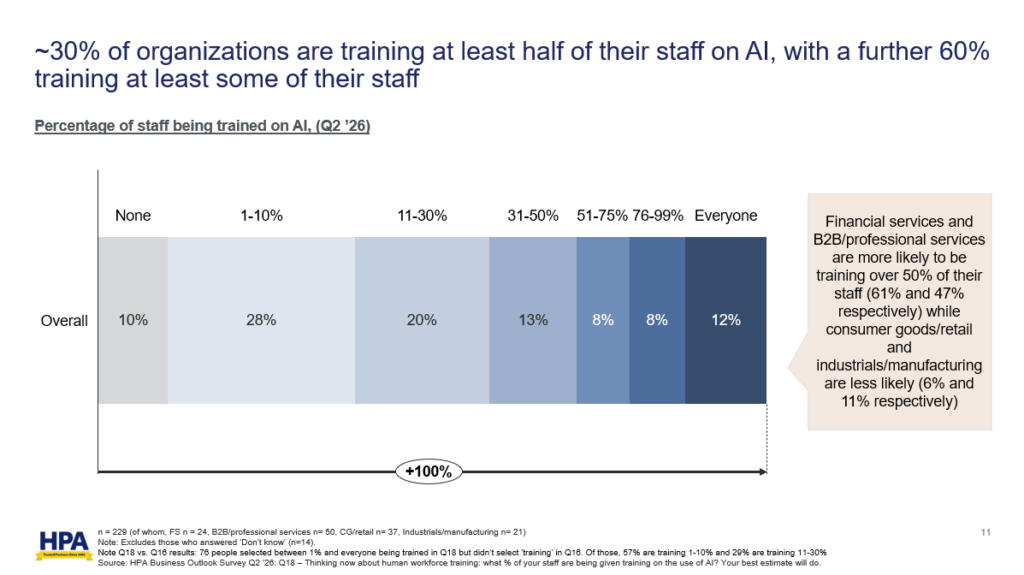
Across geographies, the extent of AI training is consistent, with 30% of U.S. organizations training more than half their staff, followed by the UK (28%) and RoW (26%).
By company size, smaller organizations lead with 38% training at least half their staff on AI, compared with 28% of large organizations and 21% of medium-sized organizations. Despite reporting the highest proportion of AI training, a notable share of small enterprises (23%) provides no AI training at all.
Effects on Recruitment and Hiring
The findings suggest AI’s effects extend beyond productivity and into hiring and workforce planning. Two-thirds (66%) of organizations globally expect AI to permanently impact the size of their future human workforce, with nearly a quarter (24%) already anticipating a decrease. This contraction in workforce size is expected to be most pronounced in the rest of the world (31%), with both the U.S. and UK expecting declines of 22%.

These effects are already visible in current hiring plans. The U.S. leads, with 38% of firms expecting to hire fewer staff this year due to AI, followed by the UK (25%) and RoW (24%). Among organizations reducing hiring, most expect modest cuts: 44% anticipate a 1-10% decline, and roughly 20% expect a steeper 11-20% reduction.
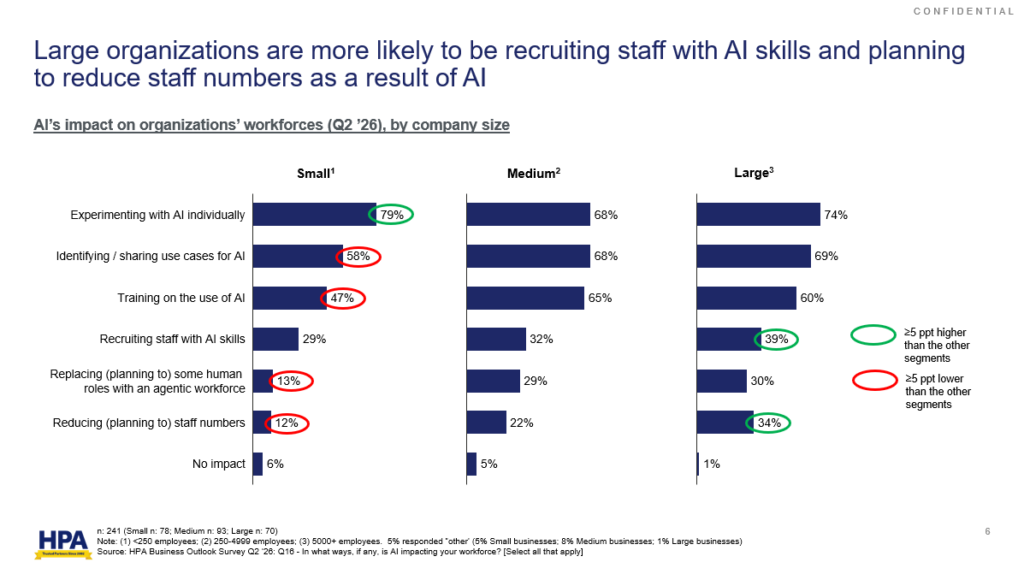
The data also reveals a divide across company size. Among larger organizations (5,000+ employees), nearly 30% are replacing or planning to replace human roles with agents, and 34% are reducing or planning to reduce staff. That figure drops to 12% and 13% across smaller organizations (<250 employees) respectively. Across all company sizes and geographies, the impact is expected to be felt most in entry and junior-level roles, customer service, and administrative support positions.
Results suggest that “wait-and-see” approaches to AI are becoming less common, as organizations move to optimize current operations while also building out agentic capabilities. Over the coming quarters, a key distinction may emerge between organizations using AI primarily to reduce administrative overhead and those restructuring their broader operating models around it.
View the full Q2 2026 survey results below:
If you missed the previously published Q2 survey results on internal factors and external threats impacting economic and business outlooks, you can read it here.
